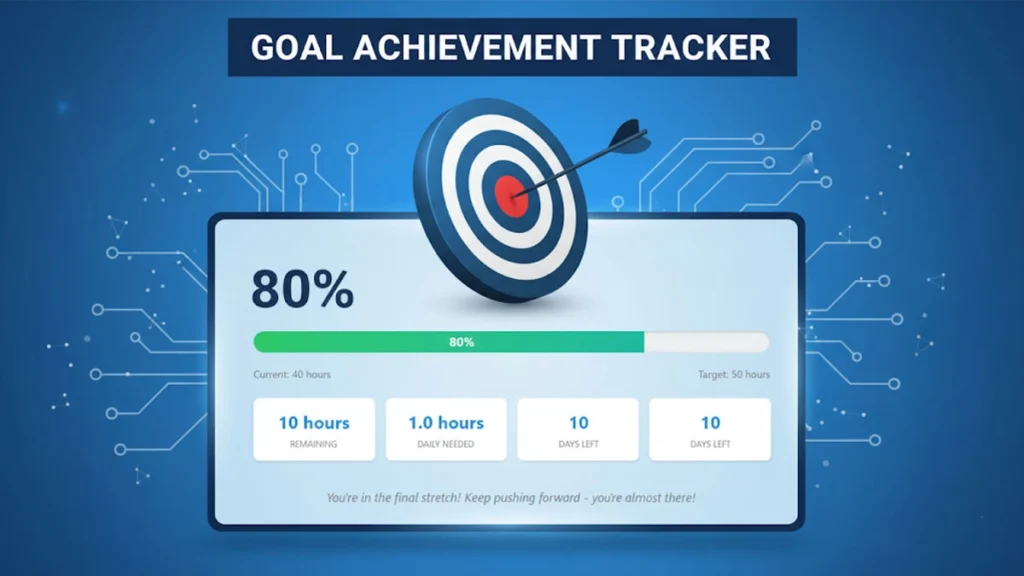
Goal Achievement Tracker
Track your progress and achieve your goals effectively
No goals saved yet. Your goal history will appear here.
⏬ Also Try ⏬
Master Your Goals: How to Use Our Goal Achievement Tracker Calculator
In our fast-paced world, setting goals is only half the battle—the real challenge lies in tracking and achieving them. Research shows that people who regularly track their goals are 42% more likely to achieve them compared to those who don’t.
That’s where our Goal Achievement Tracker Calculator comes in-a powerful, intuitive tool designed to transform how you approach goal setting and accomplishment.
This comprehensive tool isn’t just another productivity app; it’s a sophisticated system that combines visual progress tracking, motivational features, and data-driven insights to keep you on track.
What is the Goal Achievement Tracker Calculator?
The Goal Achievement Tracker Calculator is a comprehensive web-based tool designed to help individuals and teams set, monitor, and achieve their objectives efficiently. Unlike basic progress trackers, this calculator incorporates advanced features that address the psychological and practical aspects of goal achievement.
Core Components and Features
Visual Progress Monitoring
At its heart, the calculator features a dynamic progress bar that visually represents your advancement toward targets. This real-time visualization isn’t just aesthetically pleasing—it taps into psychological principles that enhance motivation. The color-changing progress bar (green for normal progress, red for exceeded targets) provides instant feedback about your performance.
Advanced Tracking Metrics
Beyond basic percentage calculations, the tool offers:
- Remaining value calculations
- Daily progress requirements
- Days remaining based on target dates
- Estimated completion dates based on current pace
- Historical data tracking
Goal Categorization System
The calculator allows you to organize goals into categories including:
- Personal development
- Professional/work objectives
- Health and fitness targets
- Educational goals
- Financial milestones
- Custom categories
Data Persistence
Through browser localStorage technology, your goals remain saved between sessions, allowing you to build a comprehensive history of your achievements and progress patterns.
How to Use the Goal Achievement Tracker Calculator: A Step-by-Step Guide
Getting Started with Basic Tracking
Step 1: Define Your Goal
Begin by entering your goal name in the “Goal Name” field. Be specific rather than vague—instead of “Get fit,” try “Lose 15 pounds in 3 months” or “Run a 5K in under 30 minutes.”
Pro Tip: Use the SMART framework (Specific, Measurable, Achievable, Relevant, Time-bound) when naming your goals for better results.
Step 2: Set Your Target and Current Progress
- Enter your target value (e.g., 100 tasks, 50 hours, $10,000)
- Input your current progress (where you are now)
- Select appropriate units (tasks, hours, points, dollars, or custom units)
Step 3: Calculate and View Progress
Click “Calculate Progress” to see your:
- Percentage completion
- Visual progress bar
- Remaining amount needed
- Motivational message based on your progress level
Advanced Features for Optimal Results
Utilizing Categories and Notes
- Assign your goal to a relevant category for better organization
- Use the notes field to document strategies, challenges, or additional context
- This metadata helps during review sessions to understand what worked and what didn’t
Setting Target Dates
- Input a target completion date to activate pace calculations
- The calculator will automatically determine:
- Daily progress needed to meet your deadline
- Days remaining
- Estimated completion date based on current pace
Example Scenario: If you need to save $3,000 in 90 days and have currently saved $600, the calculator will show you need to save $26.67 daily to reach your target.
Leveraging Goal History
- Enable the “Save to goal history” option to build your achievement database
- Access previous goals by clicking on them in the history section
- Use historical data to set more realistic future goals based on past performance
Key Benefits of Using the Goal Achievement Tracker
Enhanced Motivation and Accountability
Visual Progress Reinforcement
The dynamic progress bar provides constant visual feedback that triggers dopamine release in the brain—the same neurotransmitter associated with pleasure and motivation. This creates a positive feedback loop that encourages consistent effort.
Built-in Accountability System
Unlike traditional goal-setting methods that rely on memory or occasional check-ins, this calculator serves as your 24/7 accountability partner. The visual representation of progress (or lack thereof) provides honest, judgment-free feedback that keeps you honest with yourself.
Improved Planning and Strategy
Data-Driven Decision Making
The calculator’s advanced metrics transform vague aspirations into concrete, actionable plans. By understanding exactly how much progress you need to make daily or weekly, you can allocate time and resources more effectively.
Realistic Goal Adjustment
The tracking data helps identify when goals need adjustment. If you consistently fall short of daily targets, the calculator provides objective data to either increase your effort or adjust your timeline to more realistic parameters.
Psychological Advantages
The Progress Principle in Action
Harvard researcher Teresa Amabile discovered that visible progress is the most significant motivator in workplace settings. This calculator makes progress tangible, creating regular “small wins” that maintain momentum during challenging periods.
Reduced Overwhelm
Large goals can feel overwhelming when viewed as a single entity. By breaking them into measurable components with clear progress indicators, the calculator makes even ambitious goals feel manageable and achievable.
Advanced Tips for Maximum Effectiveness
Creating Effective Goal Structures
Balancing Goal Types
- Short-term goals: 1-3 month timelines, using the calculator for daily monitoring
- Medium-term goals: 3-12 month timelines, with weekly progress checks
- Long-term goals: 1+ year timelines, with monthly reviews and adjustments
Proportional Goal Setting
Research indicates that ideal goal difficulty is around 70-80% achievable—challenging enough to motivate but realistic enough to prevent discouragement. Use the calculator’s historical data to set goals within this optimal range.
Integration with Other Productivity Systems
Combining with Time Management Methods
- Use the calculator alongside the Pomodoro Technique for task-based goals
- Integrate with Eisenhower Matrix for priority-based goal selection
- Combine with Time Blocking for dedicated goal-achievement sessions
Linking with Habit Formation
- Use the calculator to track habit formation goals (e.g., “Meditate daily for 30 days”)
- Set progressive targets (e.g., “Increase reading time from 15 to 45 minutes daily over 6 weeks”)
- Celebrate streak milestones using the history feature
Real-World Applications and Success Stories
Personal Development Goals
Case Study: Language Learning
Maria used the calculator to track her Spanish learning goal: “Reach B2 proficiency in 6 months.” She broke this into measurable components:
- Vocabulary: 5,000 words target
- Grammar: Complete 30 lessons
- Conversation: 50 hours of practice
By tracking each component separately while monitoring overall progress, she adjusted her study methods when certain areas lagged, ultimately achieving her goal in 5.5 months.
Professional Achievement Examples
Case Study: Career Advancement
James, a marketing coordinator aiming for a manager position, used the calculator to track:
- Skill development (3 certifications in 8 months)
- Project leadership (manage 5 major campaigns)
- Network expansion (connect with 50 industry professionals)
The visual progress indicators helped him stay motivated during a demanding period, and he secured the promotion 2 months ahead of schedule.
Health and Fitness Tracking
Case Study: Weight Loss Journey
Sarah set a goal to lose 30 pounds in 4 months. Using the calculator, she tracked:
- Weekly weight measurements
- Exercise minutes
- Calorie deficits
The daily progress requirements kept her consistent, and the motivational messages provided encouragement during plateaus. She exceeded her goal, losing 35 pounds while building sustainable habits.
Common Mistakes to Avoid
Goal Setting Errors
Setting Vague Targets
- Incorrect: “Get healthier”
- Correct: “Lose 15 pounds in 3 months by exercising 4 times weekly and reducing sugar intake”
Overlooking the Process
- Mistake: Focusing only on the end result
- Solution: Use the calculator to track both outcome goals and the daily processes that lead to them
Tracking Missteps
Inconsistent Updates
- Update your progress regularly (daily for habit-based goals, weekly for larger projects)
- Set calendar reminders if needed until tracking becomes automatic
Ignoring Historical Data
- Review your goal history monthly to identify patterns
- Analyze why certain goals were achieved while others weren’t
- Apply these insights to future goal planning
Frequently Asked Questions
How often should I update my progress in the calculator?
Update your progress based on your goal type. For daily habits, update each day. For weekly targets, update weekly. For long-term projects, weekly updates work well. Consistency matters more than frequency-choose a schedule you can maintain.
Can I track multiple goals simultaneously?
Yes, you can track multiple goals by saving them to your history and loading them as needed. However, for optimal focus, we recommend concentrating on 3-5 major goals at once to avoid spreading your attention too thin.
Is my data secure and private?
Yes, all data is stored locally in your browser using localStorage technology. Your information never leaves your computer unless you explicitly export it. For additional privacy, regularly clear your browser data or use private browsing mode.
What’s the benefit of categorizing goals?
Categorization helps you maintain balance across life areas and identify patterns. You might notice you consistently achieve work goals but struggle with personal development targets, indicating where you need to adjust your approach or priorities.
How accurate are the daily needed and completion date calculations?
These calculations assume consistent progress at your current rate. They’re estimates that become more accurate as you consistently update your progress. Use them as guidelines rather than absolute predictions.
Can I use this for team or group goals?
While designed for individual use, the calculator can be adapted for team goals by having one person maintain tracking or sharing progress during team meetings. For dedicated team tracking, consider project management software with similar tracking features.
What should I do if I’m consistently behind on my daily targets?
First, assess whether your goal timeline is realistic. If it is, break your daily targets into smaller increments, eliminate distractions during work sessions, or identify obstacles preventing progress. Sometimes, adjusting the target date is more realistic than struggling with unrealistic expectations.
Conclusion and Next Steps
The Goal Achievement Tracker Calculator is more than a tool-it’s a transformation system that bridges the gap between ambition and accomplishment. By providing clear visualization of progress, actionable metrics, and historical context, it addresses both the practical and psychological aspects of goal achievement.
Remember, the calculator is available anytime you need it-bookmark it for regular access. Your future achievements await systematic tracking and consistent effort. Start mastering your goals today!
Also Check
- SMART Goals Framework: A Complete Guide
- The Psychology of Habit Formation”
- Productivity Systems Compared: Finding What Works for You
- Overcoming Procrastination: Science-Backed Strategies
- Annual Goal Planning: Creating Your Best Year Yet
References:
- American Psychological Association – Goal Setting Research
- Positive Psychology Academic Research on Motivation
- Harvard Business Review – Progress Principle Studies
- University of California Research on Habit Formation